Hire Top Talent in AI, Blockchain, and IoT for Innovative Solutions
Embrace the future with our cutting-edge tech talent. Harness the power of AI, Blockchain, IoT, and more to drive innovation and stay ahead of the curve.
eCommerce Web Development for Local Marketplaces & Hyperlocal Delivery
July 4, 2025
Classic eCommerce deliveries experienced a transition from the use of national fulfillment centers, for which customers had to wait days, or even weeks, to Quick commerce, through which products receive delivery within the same day.
Most importantly, for hot food and groceries, customers expect them to be delivered within a time frame, not over 15 – 20 minutes.
This online shopping trend requires the emergence of hyperlocal marketplaces, and that is what occurred. Quick commerce platforms pool local sellers to fulfill tightly geofenced areas.
For product owners and developers, constructing a hyperlocal commerce stack is a very different proposition from assembling a typical, country-wide store. You need to synchronize stock in real time between hundreds of neighborhood retailers, ensure a courier is on hand to send within minutes, and indicate only deliverable items.
One of the most critical aspects of creating such an eCommerce platform is Geolocation. But that is only one of the features required. In this blog, we will define the technical pillars to develop such platforms.
Whether you’re a startup venturing into local commerce or supply chains venturing into quick commerce, the technicalities involved in creating a hyperlocal eCommerce shop are largely similar.
In order to develop a good-quality local eCommerce store, you would need to ally with a good eCommerce Web Development service to guarantee proper implementation and scalability.
Understand the Hyperlocal Model
Before writing the first line of code, design the outline of your software. It should contain:
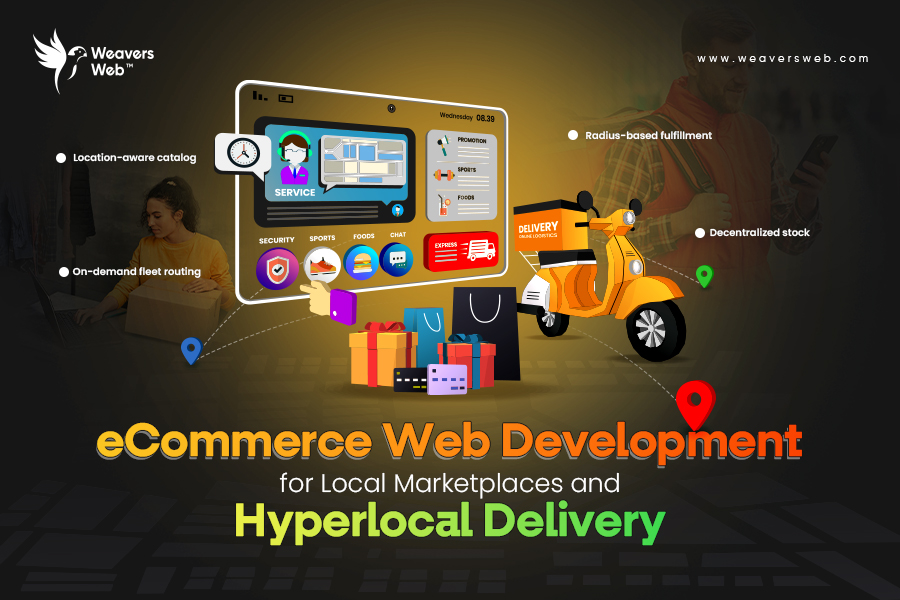
Radius-based fulfillment: Rather than national shipping areas, you will define exact service radii (usually 1–5 km) from every micro-warehouse or vendor location.
On-demand fleet routing: Couriers are assigned in real time, with ETAs typically in minutes.
Decentralized stock: Inventory resides in dozens of tiny stores instead of a big central DC. One item might be out of stock in one neighborhood but available two blocks away.
Location-aware catalog: Consumers see only SKUs that can be delivered to their address within the promised time window.
These technicalities are the foundation and have to flow through each level of your tech stack, dictating how you design your database schema, caching mechanism, and even UI micro-interactions (such as initiating a location check as soon as a user lands).
Implementing Real-Time Local Delivery Tracking with Google Maps API
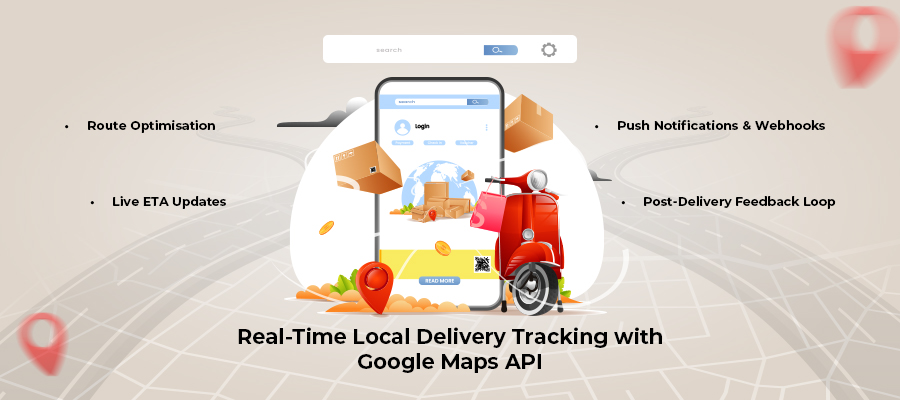
Route Optimisation:
Utilize Google Maps Directions API to calculate the quickest routes with factors taken into account, such as traffic and road conditions.
Utilize the “Trips” feature to efficiently manage multi-drop deliveries.
Live ETA Updates:
GPS tracks couriers through WebSocket at regular intervals.
Visualize the driver route through the Map’s Polyline overlay.
Push Notifications & Webhooks:
Send mobile notifications at key phases, such as “Courier assigned,” “Arriving soon,” and “Delivered.”
Webhooks enable real-time status updates from third-party logistics.
Post-Delivery Feedback Loop:
Capture GPS and timestamp to verify successful delivery.
Utilize delivery data for training models for better ETA predictions.
Being in alignment with best practices of real-time delivery: rate limit your API calls, cache map data, and encrypt location data for security.
Creating Vendor Dashboards for Local Sellers with Region-Specific Inventory Management
Your entrepreneurs are not tech experts; give them dashboards that remove friction:
Begin with a real-time stock module that supports simple CSV bulk loads, barcode scanning, and automatic low-stock alerts. But to perform hyperlocal delivery, it’s essential to take a step further- every SKU must be auto-assigned to one or more service zones. For example, if a product is out of stock in South Kolkata, it should continue to be available in North Kolkata if there is inventory available there. The dashboard would need to represent this information dynamically, rather than globally displaying that it is out of stock.
In order management, accept/decline functionality and printable pick-lists are commonplace. But in hyperlocal contexts, timing is everything. It would be a good idea to include a 60-second timer that reminds vendors to act fast; otherwise, the system should automatically reassign the order to a backup store in proximity to prevent delay.
For insights, include sales heatmaps and repeat-customer rates—but once more, localize the information. Allow vendors to see order density by neighborhood or PIN code so that they can plan promotions or even make a decision about where to locate their next dark store.
The promotions module, too, must be as flexible. Suppliers should be able to design coupons, flash sales, and bundle offers that are geographically limited—such as “₹50 discount for users within 2 km.” Geo-limited offers not only minimize delivery costs but also instill a sense of neighborly exclusivity.
Behind the scenes, keep a multi-tenant setup: each vendor’s information must reside in its own isolated schema or collection, while global services such as authentication, payment, and SMS messaging stay shared. This design keeps private data safe, makes compliance easier, and allows for easier onboarding of new sellers without disrupting current workflows.
Optimizing Checkout for Hyperlocal Payments and Same-Day Delivery Slots
Cart abandonment is so prevalent in hyperlocal marketing. There’s stiff competition, and a dozen other competing apps are just one swipe away. Therefore, you need to be careful to simplify each tap.
Easy Entry of Addresses
Auto-detect current location using HTML5 Geolocation.
Reverse-geocode to a formatted address; permit one-tap confirmation.
For favorite addresses, show a map thumbnail so the user immediately visualizes where the courier will be.
Dynamic Delivery Slots
Create slots based on fleet capacity, weather, and store cut-off times.
Implement a weighted randomization algorithm to softly nudge customers towards slots that optimize courier load.
Hyperlocal Payment Means
Weave in domestic wallets and UPI for Indian users or region-based variants like GCash (Philippines), OVO (Indonesia), etc.
Emphasize Cash on Delivery only in areas where fraud risk is minimal, tied to user trust scores and order amount.
One-Click Re-orders
Cache a user’s most recent cart by address; present a “Buy Again” CTA the instant they arrive.
Use with predictive slot pre-choice (e.g., “Deliver again tonight between 7–9?”).
Every micro-interaction saves valuable seconds, driving conversions as impulse collides with instant gratification.
Progressive Web Apps (PWAs) for Local Marketplaces: Offline Access and Rapid Browsing
Hyperlocal consumers are frequently on the go, toggling from 4G to public Wi-Fi in seconds. PWAs fill the gap between native-like smoothness and browser accessibility.
Service Workers & Caching Techniques
Cache shell HTML and key CSS/JS so the app launches right away—even in offline mode.
Use stale-while-revalidate for product images: show cached assets first, then refresh in the background.
Add to Home Screen (A2HS)
A timely prompt increases retention by allowing users a one-tap icon alongside their ride-hailing or food-ordering apps.
Ensure the manifest specifies short_name, theme_color, and 512 × 512 icons for high-DPI screens.
Background Sync
If a payment doesn’t go through due to a faulty connection, retry in the background without requiring the user to re-enter their information.
Performance Budgets
Have your overall JS payload be below ~150 KB gzipped. Each additional kilobyte devours data plans and time-to-interactive.
PWAs not only reduce development expenses, i.e., have a single codebase for web and Android, but they also enhance Lighthouse scores, thereby indirectly boosting SEO in local SERPs.
Geo-Fencing & ZIP Code-Based Product Visibility: Show the Correct Products to the Correct Places
Unintended display of pork products in a vegetarian-dominated area or booze in a dry region can give rise to PR nightmares. Hierarchical location tagging cures this.
Hierarchical Location Tags
Tag every SKU with inclusion and exclusion areas up to the postal code level.
Fall back on city-level availability if no granular tag is available.
Edge Caching with Location Keys
Employ a key pattern when caching catalog fragments in Redis or a CDN.
This allows you to render a pre-filtered list of SKUs without touching the database on each page load.
Real-Time Eligibility Check at Cart
Re-validate SKUs on address change. If an item becomes ineligible, expose a non-blocking toast—never nuke the cart completely.
Marketing Layer Integration
Push region-specific banners via your CMS. A monsoon sale can run in Mumbai, while a winter-wear promo appears in Shimla—both served from the same codebase.
Remember: your geo-logic must be idempotent and easily testable. Unit-test edge cases like borderline pin codes or newly created postal regions to avoid frustrating users at checkout.
Security, Compliance & Data Privacy Considerations
Hyperlocal platforms process intimate data: exact home addresses, live location pings, and spending habits.
Encrypt in transit and at rest – Implement TLS 1.3, HSTS, and store sensitive fields (such as phone numbers and GPS coordinates) with field-level encryption.
GDPR & regional equivalents: Even if you only sell in India, adhering to GDPR standards prepares you for future expansion.
Fraud detection: Real-time risk scoring on cash-on-delivery orders avoids “empty box” scams that bedevil last-mile ops.
Role-based access: Courier devices must only retrieve the minimum information (one-time obfuscated address) required to finish a drop-off.
A quality eCommerce Web Development service will incorporate these protections into the design to avoid bolting them on once breached.
Conclusion
Hyperlocal retail compresses the classic supply chain into a couple of square kilometers, necessitating split-second coordination between courier fleets, inventory systems, and mapping services. The secret of success is architecting for place from day one: allowing a user’s latitude and longitude to drive everything from payment options to product visibility.
By combining live delivery tracking with the Google Maps API, empowering sellers with region-aware dashboards, simplifying checkout, adopting PWAs, and geo-fencing mastery, you build a platform that somehow magically feels local—yet expands nationally when the moment is right.
If this roadmap seems intimidating, know that you don’t have to do it alone. A veteran eCommerce Web Development service can speed your go-to-market, firm up your security stance, and future-proof your stack so you can spend your time on the things that matter: making customers happy in the final mile. In the hyperlocal race, the quickest cart wins—and with the right tech, that cart is yours.





 E-Commerce & Marketplace
 Fintech
 Healthcare
 Logistics & Transport
 Travel & Hospitality
 Media & Entertainment
 Education
 Legal
Legal On-Demand
 Fitness
 Social Media
 Job Search
 Real Estate
 Sports
 Fashion & Lifestyle
 Food & Beverage