Hire Top Talent in AI, Blockchain, and IoT for Innovative Solutions
Embrace the future with our cutting-edge tech talent. Harness the power of AI, Blockchain, IoT, and more to drive innovation and stay ahead of the curve.
Realm: A Mobile Database for Offline-First Applications
March 4, 2025
In today’s world, people expect mobile apps to work anytime, anywhere—whether commuting on the subway, hiking in a remote area, or just dealing with a weak Wi-Fi signal. But here’s the challenge: not everyone has a stable internet connection all the time. That’s why offline functionality isn’t just a bonus feature—it’s an absolute necessity.
This is where Realm comes in. Suppose you’re building a mobile app that needs to function smoothly without constant internet access; the Realm mobile database stores data locally so that you face no difficulty in using it offline. In this post, we’ll dive into what Realm is, why it’s a game-changer for offline-first apps, and how you can integrate it into your mobile development workflow.
What is Realm?
At its core, Realm is a mobile-first database designed for speed, efficiency, and offline functionality. Unlike traditional SQL-based databases that rely on tables and queries, Realm takes a different approach—it uses an object-oriented data model.
What does that mean for developers? Instead of writing complex SQL queries to manipulate data, you work with objects just like you would in your programming language. This is good news for mobile developers as the experience feels more intuitive and natural.
But that’s not all. Realm offers:
Blazing-fast performance – Reads and writes happen almost instantly.
Seamless offline support – Data is stored locally and syncs when online.
Real-time updates – Any database changes are instantly reflected in the app.
Lightweight footprint – Doesn’t hog memory or drain battery life.
In short, Realm makes it ridiculously easy for users to manage local data while keeping things smooth and snappy.
Realm provides many benefits if you’re developing an app that needs to function without a constant internet connection. Let’s break down some of the key advantages:
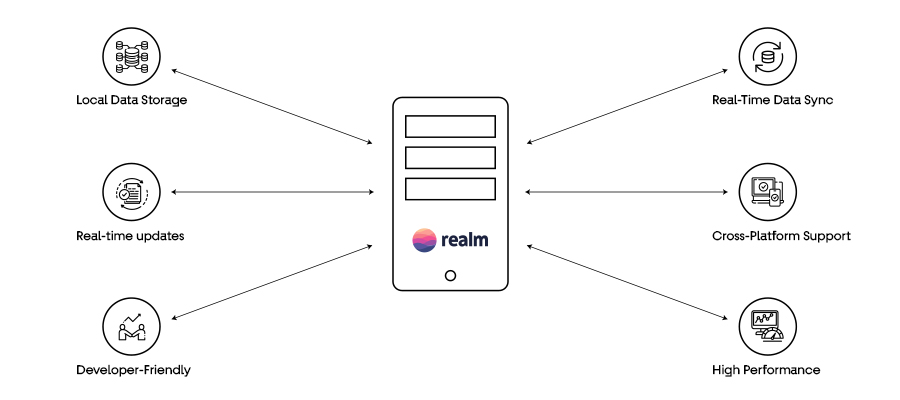
1. Local Data Storage
One of Realm’s most attractive features is its built-in offline data storage facility. In contrast to cloud-based databases, which need an internet connection to read the data, Realm does it all in a flash, directly on the user’s device. This means your app remains fully functional even when offline. Upon loading data, the app is perceived as fast and responsive. Users never lose their progress—everything is saved locally.
Data persistence is also an important part of apps such as note-taker, task manager, and an e-commerce service. Using Realm, users can seamlessly continue to work, whether online or offline.
2. Real-Time Data Sync
Data synchronization between a device and a server, however, can be quite a struggle down the road if not carried out correctly. Fortunately, Realm makes real-time synchronization incredibly smooth. Here’s how it works:
When a user is offline, changes are stored locally. As soon as they get reconnected, Realm will keep the new data synced to the server.
This is a paradigm shift for chat apps, groupware, or any application that needs up-to-date information. No more clunky manual refreshes—Realm does the heavy lifting for you.
3. Developer-Friendly
It is a common practice that nobody enjoys working with complex APIs or writing thousands of lines of boilerplate code. Realm keeps things simple with an intuitive API that lets you:
Define data models as objects (no need for table schemas).
Perform CRUD operations (create, read, update, delete) with minimal effort.
Use built-in query methods that feel natural in your preferred language.
The result? Less time spent debugging, faster development, and cleaner code.
4. High Performance
When it comes to performance, Realm is built for speed. Unlike traditional databases that rely on disk-based storage, Realm operates in memory, making it incredibly fast.
Even with large datasets, Realm ensures that:
Queries execute in milliseconds.
The app doesn’t slow down as data grows.
Users get a buttery-smooth experience without lag.
For performance-driven apps like real-time dashboards, social media platforms, or financial tracking tools, this is a huge advantage.
5. Cross-Platform Support
Whether you’re building for iOS, Android, or both, Realm has you covered. Its cross-platform capabilities mean you can:
Write code once and use it across multiple platforms.
Maintain a single codebase, reducing development time.
Sync data seamlessly between different devices.
This makes Realm an ideal choice for startups and large-scale applications alike, helping teams in fast mobile app development.
How Realm Works in Offline Mode
So, how exactly does Realm handle offline functionality? Let’s break it down:
Data Storage on the Device
Realm keeps everything in a secure, self-contained database file on the user’s device. Unlike cloud-based databases, there’s zero dependency on an internet connection to access data.
Automatic Data Sync
Whenever a device goes offline, Realm continues to store updates locally. Once an internet connection is restored, it automatically syncs the changes with the server—no extra work is required.
Conflict Resolution
What happens if two users modify the same data while offline? Realm’s built-in conflict resolution algorithms ensure that the most recent and relevant data is saved, keeping everything consistent and error-free.
Integrating Realm into Your Mobile App
Adding Realm to your app is straightforward. Here’s a quick overview of the process:
Installation – Use CocoaPods (iOS) or Gradle (Android) to install Realm.
Setup & Configuration – Define where data is stored and tweak settings as needed.
Define Data Models – Create classes that represent your data.
Perform CRUD Operations – Use Realm’s simple API to read, write, update, and delete data.
Test & Debug – Utilize Realm’s debugging tools to ensure smooth performance.
The official documentation is well-written and beginner-friendly, making the setup process easy—even for first-time users.
Wondering what types of apps benefit the most from Realm? Here are a few examples:
Note-Taking Apps – Store notes locally and sync them later.
E-Commerce Apps – Save shopping carts and sync orders once online.
Health & Fitness Apps – Track user activity without an internet connection.
Messaging Apps – Ensure messages are saved and delivered reliably.
The Future of Offline-First Apps with Realm
As mobile development trends evolve, offline-first functionality is becoming the standard rather than the exception. Realm is constantly improving, adding new features, and expanding its ecosystem to stay ahead of the curve.
Realm is a smart choice if you’re building an app that needs to work offline, sync seamlessly, and run efficiently.





 E-Commerce & Marketplace
 Fintech
 Healthcare
 Logistics & Transport
 Travel & Hospitality
 Media & Entertainment
 Education
 Legal
Legal On-Demand
 Fitness
 Social Media
 Job Search
 Real Estate
 Sports
 Fashion & Lifestyle
 Food & Beverage